For some women, IVF with their own eggs may become difficult because of reduced ovarian reserve, age-related changes in egg quality, premature ovarian insufficiency, certain genetic concerns, or repeated treatment problems. In selected situations, donor egg IVF in Surat may provide another pathway to pregnancy.
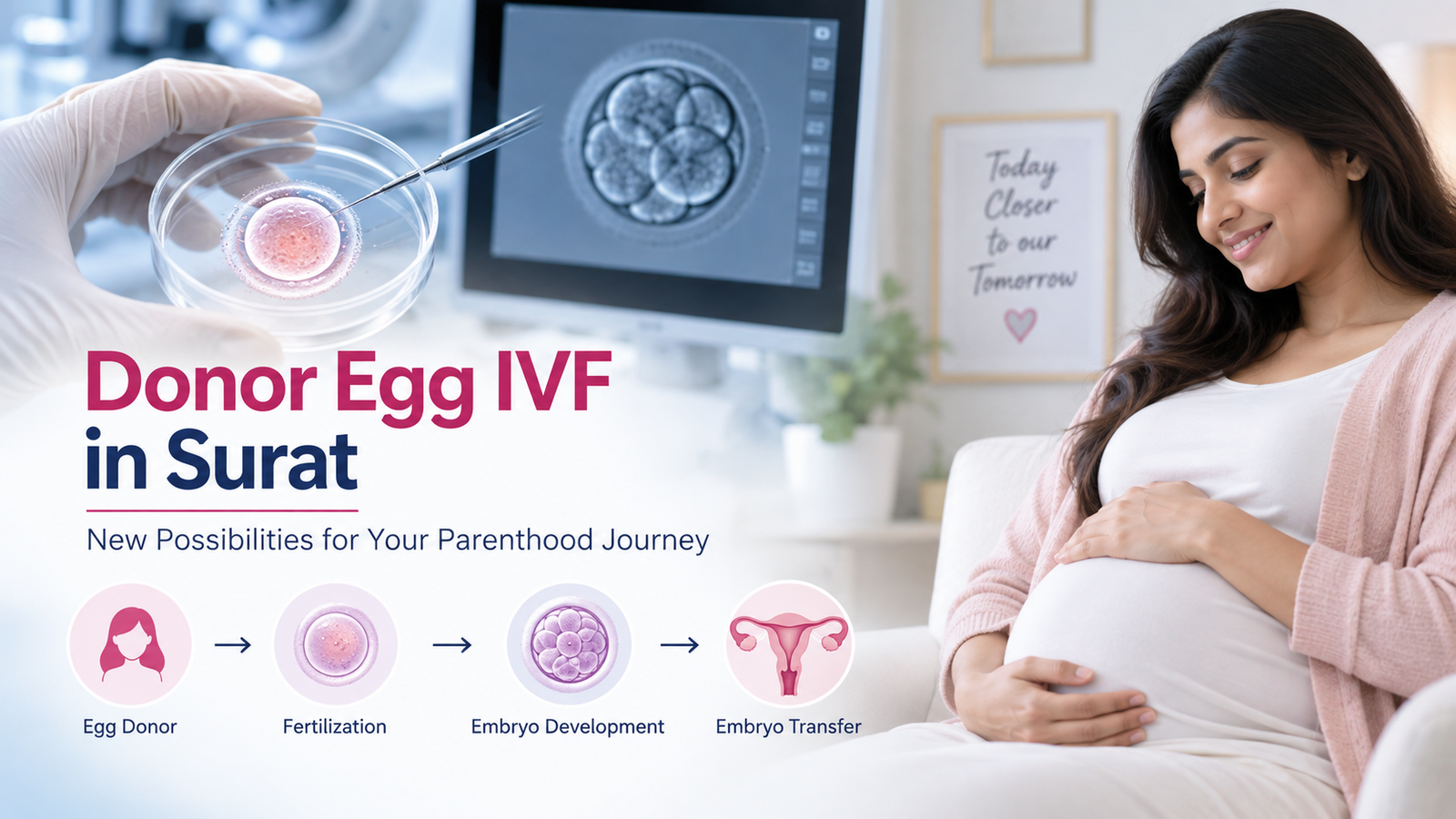
In donor egg IVF, fertility specialists use eggs from an eligible donor rather than retrieving eggs from the intended mother. The embryology team fertilizes the donor eggs with sperm, monitors embryo development, and transfers a suitable embryo into the intended mother’s uterus when appropriate.
Donor egg treatment is not automatically the next step after an unsuccessful IVF cycle. A fertility specialist first needs to review the woman’s age, ovarian reserve, medical history, previous IVF response, uterine health, and the couple’s fertility factors before recommending treatment.
What Is Donor Egg IVF?
Donor egg IVF is a form of in vitro fertilization in which the treatment uses donated eggs.
In a standard IVF treatment in Surat, fertility specialists stimulate the ovaries, retrieve eggs, fertilize them in the laboratory, monitor embryo development, and then plan embryo transfer.
With donor egg IVF, the eggs come from a donor instead of the intended mother. The fertility team then uses sperm from the intended father or another legally and medically appropriate source, depending on the individual treatment plan and applicable regulations.
The intended mother still carries the pregnancy after embryo transfer, provided her uterus and overall health make pregnancy medically appropriate.
Who May Need Donor Egg IVF?
A fertility specialist may discuss donor eggs when there is a significant problem with the availability or reproductive potential of a patient’s own eggs.
Possible situations include:
- Very low ovarian reserve
- Premature ovarian insufficiency
- Advanced reproductive age with significantly reduced egg quality
- Repeated poor ovarian response during IVF
- Repeated cycles that produce no suitable embryos
- Certain inherited genetic conditions
- Previous ovarian surgery or treatment that has significantly affected ovarian function
- Medical situations where using the patient’s own eggs is not feasible
Age alone does not automatically mean a woman requires donor eggs. Ovarian reserve, previous treatment response, overall reproductive health, and individual goals also matter.
Paaranu IVF notes that fertility outcomes can vary according to factors such as age, egg and sperm quality, and the underlying cause of infertility.
Why Does Egg Quality Matter in IVF?
Egg quality plays an important role in fertilization and embryo development.
As reproductive age increases, both the quantity and reproductive potential of available eggs can decline. However, chronological age does not tell the complete story. Two women of the same age may have very different ovarian reserves and responses to fertility treatment.
A fertility specialist may therefore consider several factors, including ovarian reserve testing, ultrasound findings, previous egg retrieval results, fertilization history, and embryo development.
Patients should not decide to use donor eggs based on a single test result without a complete fertility evaluation.
How Does Donor Egg IVF in Surat Work?
The exact treatment pathway varies between patients, but donor egg IVF generally involves several coordinated stages.
1. Fertility Evaluation
The process begins with a detailed fertility consultation.
The fertility specialist reviews the couple’s medical and reproductive history, previous fertility treatment, menstrual history, ovarian reserve, sperm factors, and other relevant information.
The doctor may also evaluate whether the intended mother can safely carry a pregnancy.
This stage helps determine whether donor egg IVF is medically appropriate or whether another fertility treatment should be considered first.
2. Donor Eligibility and Screening
Donor selection is a medically and legally regulated part of treatment.
The treatment centre must follow applicable Indian assisted-reproduction laws, regulations, eligibility requirements, and screening procedures. Patients should ask their fertility clinic how the donor programme works and what information can legally be provided about the donor.
Screening and eligibility requirements aim to protect the donor, intended parents, and potential child.
The exact tests and documentation depend on applicable regulations and clinical requirements.
3. Preparing the Intended Mother
While the donor-related treatment proceeds according to the prescribed protocol, the fertility team prepares the intended mother for embryo transfer.
The endometrium, the inner lining of the uterus, needs appropriate preparation and timing.
Doctors may prescribe hormonal medicines and monitor the uterine lining with ultrasound. The exact protocol depends on the patient’s menstrual function, medical history, and treatment plan.
Patients should take medicines exactly as prescribed because timing plays an important role in coordinating the endometrium with embryo development or transfer.
4. Egg Retrieval
After appropriate ovarian stimulation and monitoring, the clinical team retrieves mature eggs from the donor according to the treatment protocol.
The embryology team then evaluates the retrieved eggs in the laboratory.
5. Fertilization
The laboratory fertilizes suitable mature eggs using the planned method.
Conventional IVF may work for some cases. When significant male-factor infertility or specific fertilization concerns exist, the fertility specialist may recommend ICSI.
During ICSI treatment in Surat, an embryologist selects a sperm and injects it directly into a mature egg to assist fertilization.
ICSI can help with the fertilization step in selected cases, but it cannot guarantee embryo development, implantation, or pregnancy.
6. Embryo Development
After fertilization, embryologists monitor the developing embryos under controlled laboratory conditions.
Not every fertilized egg develops at the same rate or reaches the stage required for transfer or freezing.
In selected treatment plans, the laboratory may continue embryo development to the blastocyst stage. Paaranu IVF also provides blastocyst culture among its fertility services.
The fertility team determines the appropriate embryo-transfer strategy according to the individual cycle.
7. Embryo Transfer
At the planned time, the fertility specialist transfers a suitable embryo into the intended mother’s uterus using a thin catheter passed through the cervix.
The procedure usually does not require an abdominal incision.
The clinic then provides instructions about medicines, routine activity, follow-up, and the appropriate date for pregnancy testing.
Can Donor Egg Embryos Be Frozen?
Depending on embryo development, treatment requirements, consent, and applicable regulations, suitable embryos that are not transferred during the current cycle may be considered for cryopreservation.
Cryopreservation in Surat allows fertility laboratories to preserve embryos, eggs, or sperm for potential future use.
If frozen embryos remain available, a future attempt may involve frozen embryo transfer rather than another complete donor egg stimulation and retrieval process.
The fertility team should explain storage, consent, duration, costs, and regulatory requirements before cryopreservation.
What Factors Affect Donor Egg IVF Success?
Donor eggs can address an important egg-related fertility factor, but they do not eliminate every variable involved in achieving pregnancy.
Several factors may affect treatment outcomes.
Donor Egg Factors
The characteristics and quality of the donated eggs can influence fertilization and embryo development.
Sperm Quality
Sperm also contributes to fertilization and embryo development. Significant male-factor infertility may therefore influence the laboratory strategy.
Embryo Development
Not every fertilized egg becomes a transferable embryo. Embryologists monitor development before determining which embryos may be suitable for transfer or preservation.
Uterine Health
The uterus and endometrium need appropriate evaluation and preparation before embryo transfer.
Conditions affecting the uterine cavity may require assessment or treatment before proceeding.
Embryo Transfer
Careful timing and coordination between embryo development and endometrial preparation form an important part of treatment.
General Health
The intended mother’s overall health also matters because she will carry the pregnancy.
Pre-pregnancy evaluation can identify medical conditions that require treatment or monitoring before conception.
Does Donor Egg IVF Guarantee Pregnancy?
No.
Donor egg IVF cannot guarantee implantation, pregnancy, or live birth.
Although donor eggs can address certain problems related to a patient’s own egg supply or egg quality, many other biological factors still influence the outcome.
Patients should be cautious about any claim that a particular IVF or donor egg treatment guarantees pregnancy.
A fertility specialist can provide a more individualized discussion after reviewing the couple’s medical history and treatment circumstances.
Donor Egg IVF vs IVF With Your Own Eggs
| Factor | IVF With Own Eggs | Donor Egg IVF |
|---|---|---|
| Egg source | Intended mother | Eligible donor |
| Ovarian stimulation of intended mother | Usually required | Generally not required for egg retrieval |
| Egg retrieval from intended mother | Yes | No |
| Fertilization | Laboratory | Laboratory |
| Embryo transfer | Into intended mother’s uterus | Into intended mother’s uterus |
| Genetic contribution from intended mother’s egg | Yes | No |
| Pregnancy carried by intended mother | Usually | Usually, if medically suitable |
Understanding the genetic difference is important before treatment. Counselling and a detailed discussion with the fertility team can help intended parents make an informed decision.
What Should Couples Ask Before Donor Egg IVF?
Before starting treatment, couples should understand both the medical process and the practical implications.
Useful questions include:
- Why are donor eggs being recommended in our case?
- Are there reasonable alternatives using our own eggs?
- What donor screening and eligibility requirements apply?
- What information can legally be provided about the donor?
- Which fertilization method will the laboratory use?
- Will embryos develop to the blastocyst stage?
- What happens to additional suitable embryos?
- What medicines will the intended mother need?
- What costs are included in the treatment plan?
- Which legal consent documents are required?
- What happens if fertilization or embryo development does not occur as expected?
A transparent consultation should give couples enough information to understand the treatment rather than simply promising a particular outcome.
Preparing for Donor Egg IVF
Preparation varies according to the patient’s medical circumstances.
The intended mother may need fertility assessment, uterine evaluation, blood investigations, and other pre-pregnancy tests.
Patients should also tell their fertility specialist about prescription medicines, supplements, previous surgeries, chronic medical conditions, and previous fertility treatments.
During treatment, follow the prescribed medicine schedule and attend monitoring appointments as instructed.
Lifestyle measures such as avoiding smoking, limiting or avoiding alcohol according to medical advice, eating a balanced diet, and managing existing medical conditions can support general pre-pregnancy health. However, no diet, supplement, or home remedy can guarantee implantation.
Donor Egg IVF in Surat at Paaranu IVF
Couples considering donor egg IVF in Surat should first undergo an individualized fertility assessment to determine why previous conception or IVF attempts have been difficult and whether donor eggs represent an appropriate treatment pathway.
Paaranu IVF provides fertility evaluation and assisted reproductive treatments in Surat. Its current fertility services include IVF, IUI, ICSI, IMSI, assisted hatching, cryopreservation, blastocyst culture, and other reproductive treatments.
Dr. Jayesh Patel, MD, D.G.O., Clinical Director at Paaranu IVF, has more than 25 years of experience in gynecology, fertility, and fetal medicine.
A consultation can help couples understand whether donor egg IVF is appropriate for their fertility circumstances, which investigations they need, and how the treatment and embryo-transfer process would be planned.
Conclusion
Donor egg IVF in Surat may provide a treatment option when using the intended mother’s own eggs is unlikely to be feasible or appropriate because of significantly reduced ovarian reserve, poor response, age-related egg factors, certain genetic concerns, or other fertility conditions.
The process involves much more than obtaining donor eggs. It requires appropriate donor eligibility and screening, fertility evaluation of the intended parents, laboratory fertilization, embryo development, preparation of the intended mother’s uterus, and carefully timed embryo transfer.
Donor eggs can address specific egg-related fertility problems, but they cannot guarantee pregnancy. Embryo development, sperm quality, uterine health, maternal health, and other factors can still influence the outcome.
Couples considering donor eggs should discuss the medical, emotional, legal, and practical aspects with a qualified fertility team before deciding whether this approach is right for them.
Frequently Asked Questions
Who may need donor egg IVF?
Doctors may consider donor eggs for women with severely reduced ovarian reserve, premature ovarian insufficiency, repeated poor IVF response, certain genetic conditions, or other significant egg-related fertility problems.
Can I carry the pregnancy if I use donor eggs?
Yes, many intended mothers carry pregnancies created with donor eggs if their uterus and overall health make pregnancy medically appropriate.
Is the baby genetically related to the intended mother?
The donor provides the egg’s genetic material, so the child does not inherit the intended mother’s DNA through the donated egg.
Does donor egg IVF guarantee pregnancy?
No. Donor egg IVF cannot guarantee pregnancy or live birth. Embryo development, sperm factors, uterine health, maternal health, and other factors can influence outcomes.
Is ICSI always required with donor eggs?
No. The fertility team decides whether conventional IVF or ICSI is appropriate based on sperm factors, fertilization history, and the individual treatment plan.
Can extra embryos from donor egg IVF be frozen?
Suitable additional embryos may be eligible for cryopreservation depending on embryo development, consent, the treatment plan, and applicable regulations.