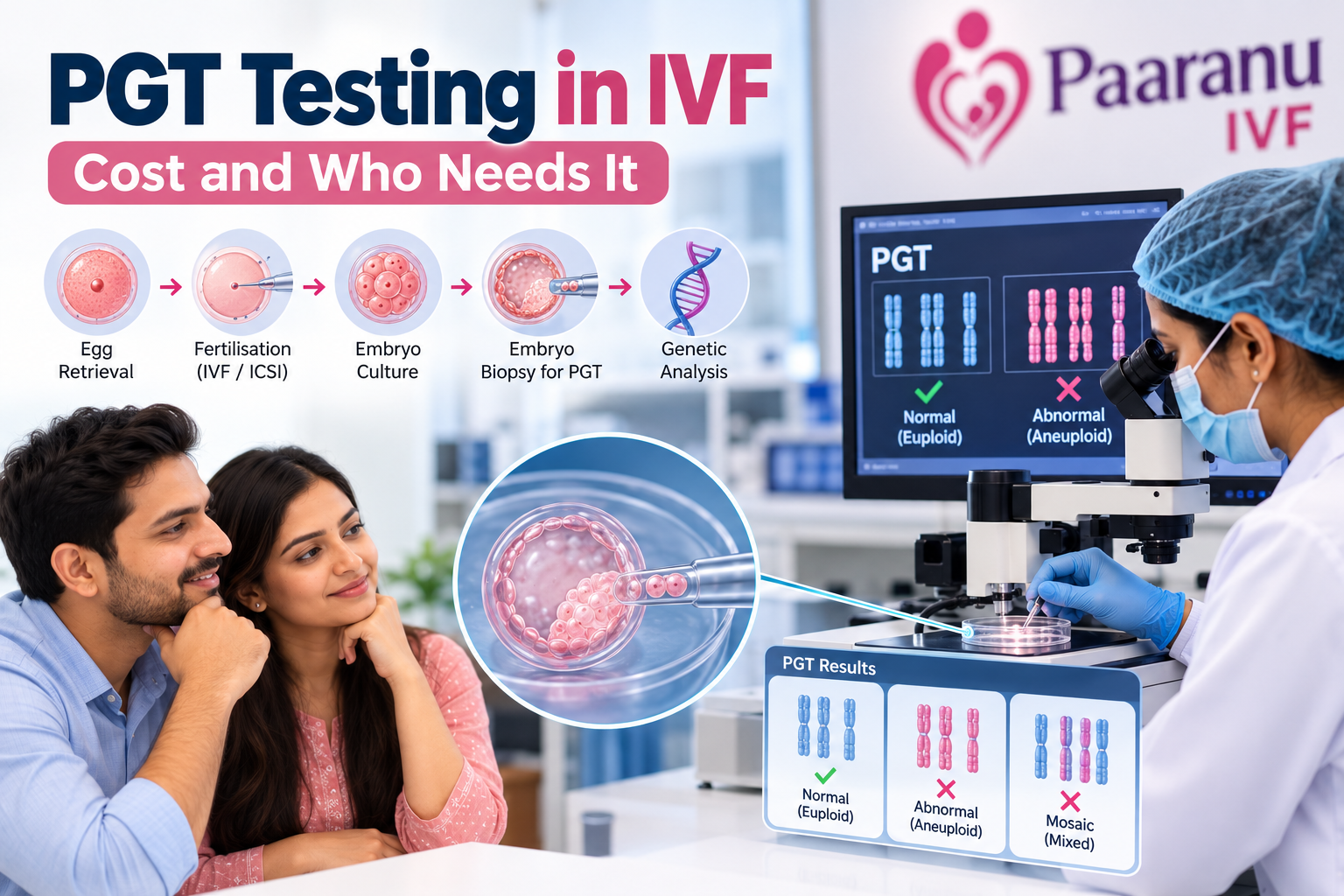
Preimplantation Genetic Testing, or PGT, is a laboratory test used during IVF to examine embryos for certain genetic or chromosomal abnormalities before embryo transfer. For couples searching for PGT testing IVF cost in India, the total price depends on the type of PGT, the number of embryos tested, embryo biopsy charges, genetic laboratory fees, freezing, and the underlying IVF treatment.
At Paaranu IVF in Surat, fertility treatment is guided by Dr. Jayesh Patel, MD, D.G.O., Clinical Director & IVF Specialist, who has more than 25 years of experience in gynecology, fertility, and fetal medicine.
What Is PGT Testing in IVF?
PGT stands for Preimplantation Genetic Testing.
During IVF, eggs are fertilised in the laboratory and embryos develop for several days. When an embryo reaches the blastocyst stage, an embryologist may remove a small number of cells from the outer layer of the embryo.
A specialised genetics laboratory then analyses those cells.
Doctors may use PGT to look for:
- Abnormal chromosome numbers
- Specific inherited genetic diseases
- Structural chromosome abnormalities
The embryo usually remains frozen while the laboratory completes the testing.
What Are the Main Types of PGT?
PGT is not a single test.
The three main categories are:
PGT-A
PGT-A means Preimplantation Genetic Testing for Aneuploidy.
It checks whether an embryo has the expected number of chromosomes.
Embryos with extra or missing chromosomes may have a lower chance of implantation or a higher chance of miscarriage or chromosomal conditions.
However, the American Society for Reproductive Medicine states that routine PGT-A for every IVF patient has not been proven to improve overall pregnancy outcomes.
PGT-M
PGT-M means Preimplantation Genetic Testing for Monogenic Disorders.
Doctors may consider it when one or both parents have a known risk of passing on a specific single-gene disorder.
Examples may include certain inherited conditions such as:
- Thalassemia
- Cystic fibrosis
- Huntington disease
- Some X-linked disorders
PGT-M usually requires careful genetic work-up and counselling before the IVF cycle begins.
PGT-SR
PGT-SR means Preimplantation Genetic Testing for Structural Rearrangements.
Doctors may recommend it when one parent carries a chromosomal rearrangement such as a balanced translocation or inversion.
These rearrangements can increase the chance of embryos having an unbalanced chromosome pattern.
How Does PGT Testing Work During IVF?
PGT adds several laboratory steps to the IVF process.
1. Ovarian Stimulation
The fertility specialist gives medicines to stimulate the ovaries so that multiple follicles can develop.
2. Egg Retrieval
Doctors retrieve mature eggs from the ovaries.
3. Fertilisation
Embryologists fertilise eggs using conventional IVF or ICSI, depending on the clinical situation.
4. Embryo Culture
The laboratory allows fertilised eggs to grow into embryos.
PGT biopsy usually takes place when suitable embryos reach the blastocyst stage.
5. Embryo Biopsy
An embryologist removes a small sample of cells from the trophectoderm, which later contributes mainly to placental tissue.
6. Embryo Freezing
The laboratory generally freezes the biopsied embryo while awaiting the genetic result.
7. Genetic Analysis
The testing laboratory analyses the biopsy sample for the specific type of PGT requested.
8. Embryo Transfer
After reviewing the results, the fertility specialist may plan a frozen embryo transfer using an embryo considered suitable for transfer.
Patients who want to understand the overall fertility process can read Paaranu IVF’s IVF treatment in Surat information.
What Is the PGT Testing IVF Cost in India?
The PGT testing IVF cost in India varies considerably because clinics and genetic laboratories use different pricing structures.
Current published 2026 estimates suggest approximate ranges such as:
- ₹17,000–₹30,000 per embryo for biopsy and genetic analysis in some centres
- Around ₹40,000–₹1,50,000 as an additional PGT-A cycle cost depending on the number of embryos
- Approximately ₹2.2 lakh–₹4.5 lakh for complete IVF plus PGT-A packages at some centres
These figures are broad market estimates rather than Paaranu IVF’s confirmed charges.
Patients should request a personalised written estimate before treatment because the final price may differ significantly.
What Factors Affect PGT Testing Cost?
Several factors influence the total cost.
Number of Embryos Tested
Some laboratories charge per embryo.
Therefore, testing six embryos may cost more than testing two.
Type of PGT
PGT-A, PGT-M and PGT-SR involve different laboratory processes.
PGT-M may require customised test development for a known familial genetic condition, which can increase cost.
IVF and ICSI Charges
PGT does not replace IVF.
Patients still need ovarian stimulation, egg retrieval, fertilisation and embryo culture.
ICSI may also add to the overall treatment cost when clinically recommended.
Embryo Biopsy
Embryo biopsy requires specialised laboratory expertise and contributes to the total charge.
Genetic Laboratory Fees
The biopsy sample usually goes to a specialised genetics laboratory for testing.
The platform used may affect pricing.
Embryo Freezing and Storage
Because embryos often remain frozen while results are pending, cryopreservation and storage fees may apply.
Frozen Embryo Transfer
The later transfer cycle may carry separate charges.
Is PGT Included in the Normal IVF Cost?
Usually, no.
Most fertility centres treat PGT as an additional procedure beyond standard IVF charges.
A complete estimate may include:
- IVF consultation
- Fertility medicines
- Monitoring scans
- Egg retrieval
- Anaesthesia
- Embryology charges
- ICSI if required
- Blastocyst culture
- Embryo biopsy
- Genetic testing
- Embryo freezing
- Storage
- Frozen embryo transfer
Ask the clinic exactly which services the quoted amount includes.
Who May Need PGT Testing During IVF?
PGT may help selected patients, but not every IVF patient needs it.
Doctors may discuss PGT in situations such as:
- Known inherited genetic disease
- Balanced chromosomal rearrangement
- Previous pregnancy affected by a genetic condition
- Recurrent miscarriage with evidence suggesting chromosomal causes
- Advanced maternal age in selected circumstances
- Multiple IVF cycles with suitable clinical indications
The reason for testing matters because PGT-A, PGT-M and PGT-SR answer different questions.
Is PGT Recommended for Older Women?
Maternal age strongly affects the chance of chromosome abnormalities in eggs and embryos.
For this reason, some patients of advanced reproductive age discuss PGT-A with their fertility specialist.
However, ASRM does not recommend routine PGT-A for every IVF patient. Evidence suggests that some older patients may potentially benefit in selected situations, particularly when they produce enough blastocysts for testing, but counselling should remain individualised.
Is PGT Useful After Recurrent Miscarriage?
Some miscarriages occur because embryos have abnormal chromosome numbers.
PGT-A may therefore become part of the discussion for selected patients with recurrent pregnancy loss.
However, recurrent miscarriage has many possible causes.
Other factors can include:
- Uterine abnormalities
- Hormonal problems
- Genetic rearrangements
- Autoimmune or clotting-related conditions
- Age-related egg factors
The fertility specialist should investigate the cause rather than automatically recommending PGT.
Can PGT Help With Repeated IVF Failure?
Possibly, but it depends on why previous IVF cycles failed.
PGT-A may help identify embryos with apparently normal chromosome numbers, but embryo chromosome status is only one factor involved in implantation.
Repeated IVF failure may also relate to:
- Embryo quality
- Uterine conditions
- Endometrial factors
- Laboratory factors
- Egg quality
- Sperm factors
- Other medical causes
PGT should therefore form part of a broader fertility assessment.
Is PGT Recommended for Severe Male Infertility?
Not automatically.
ASRM notes that currently available evidence does not support using PGT-A simply because severe male-factor infertility is present.
Patients with sperm-related fertility problems can first explore appropriate male infertility treatment in Surat before deciding whether genetic embryo testing adds value.
What Is PGT-M and Who Needs It?
PGT-M targets a specific known single-gene disorder.
A couple may consider PGT-M when:
- One partner has an autosomal dominant disease
- Both partners carry the same autosomal recessive disorder
- The family carries an X-linked genetic condition
- Previous testing identifies a pathogenic genetic variant
ASRM recommends genetic counselling before PGT-M, so patients understand the disease, inheritance pattern, limitations of testing, and other reproductive options.
Why Is Genetic Counselling Important Before PGT?
Genetic counselling can help couples understand:
- What condition the test looks for
- Whether the test can answer their specific question
- Possible results
- Limitations of embryo biopsy
- Mosaic results
- Inconclusive results
- Possibility of misdiagnosis
- Prenatal testing options after pregnancy
ASRM emphasises counselling before and after PGT, particularly for PGT-M and complex PGT-A results.
Does PGT Guarantee a Healthy Baby?
No.
PGT cannot guarantee:
- Implantation
- Pregnancy
- Live birth
- Absence of every genetic disorder
- Absence of birth defects
- A completely healthy child
PGT tests specific genetic or chromosomal features based on a small sample of embryo cells.
It does not examine every possible medical condition.
Does PGT Improve IVF Success Rates?
The answer depends on the patient group and the type of PGT.
PGT-A may help select embryos with apparently normal chromosome numbers for transfer.
However, ASRM states that current evidence does not support routine PGT-A for all IVF patients, and several trials found similar overall pregnancy outcomes between PGT-A and conventional IVF in favourable-prognosis patients.
Therefore, clinics should not present PGT as a guaranteed method to improve IVF success.
Can PGT Reduce the Risk of Miscarriage?
Some miscarriages result from embryo aneuploidy.
Selecting an embryo reported as euploid may reduce the transfer of embryos with obvious chromosome abnormalities.
However, ASRM notes that the overall effect of routine PGT-A on miscarriage and cumulative live-birth outcomes remains uncertain.
Miscarriage can also occur for reasons unrelated to embryo chromosomes.
What Does a Euploid Embryo Mean?
A euploid embryo has a chromosome result that falls within the expected range on PGT-A.
An aneuploid embryo shows extra or missing chromosomal material.
A mosaic embryo contains a mixture of cell results.
Mosaic findings require careful interpretation because some mosaic embryos may still implant and result in healthy births. ASRM recommends detailed counselling when mosaic results occur.
Can PGT Results Be Inconclusive?
Yes.
Sometimes the laboratory cannot provide a clear result.
ASRM reports that inconclusive PGT-A results can occur in a small percentage of biopsies.
In such cases, the fertility and genetics teams may discuss:
- Re-biopsy
- Continued storage
- Transfer considerations
- Alternative testing strategies
The decision depends on embryo quality, previous results, and patient preferences.
Does Embryo Biopsy Damage the Embryo?
Modern PGT commonly uses trophectoderm biopsy at the blastocyst stage.
This approach removes cells from the outer layer rather than the cells that directly form the fetus.
Studies suggest experienced laboratories can perform trophectoderm biopsy with limited detectable impact, although embryo biopsy is still an invasive laboratory procedure and cannot be considered completely risk-free.
Laboratory skill therefore matters.
Why Are Embryos Usually Frozen After PGT Biopsy?
Genetic testing results generally take time.
After biopsy, the laboratory commonly vitrifies the embryo and keeps it frozen until results become available.
The patient can then undergo a frozen embryo transfer cycle if a suitable embryo is available.
You can learn more about embryo freezing through Paaranu IVF’s fertility treatment services and cryopreservation options.
Is ICSI Required for PGT?
Not always.
ASRM notes that ICSI may be preferred in some PGT settings and is often used with PGT-M to reduce the risk of contamination from extra sperm or surrounding cells.
However, routine ICSI solely because a patient is undergoing PGT-A is not supported by sufficient evidence.
Your fertility specialist and embryologist should decide based on the clinical situation.
Can PGT Tell the Baby’s Sex?
Chromosome testing may reveal information related to sex chromosomes.
However, in India, sex selection for non-medical purposes is legally restricted.
PGT should be used for appropriate medical indications rather than choosing a child’s sex.
Patients should follow Indian ART and prenatal diagnostic regulations and discuss any genetic testing only with a qualified fertility and genetics team.
Do You Still Need Pregnancy Testing After PGT?
Yes.
PGT examines embryos before transfer, but pregnancy still requires successful implantation and continued development.
After embryo transfer, patients need the usual:
- Pregnancy testing
- Early ultrasound
- Antenatal care
Is Prenatal Testing Still Needed After PGT?
Often, yes.
PGT reduces certain genetic risks but does not replace all prenatal screening or diagnostic testing.
For pregnancies conceived after PGT-M, ASRM recommends offering prenatal testing because technical limitations mean embryo testing cannot guarantee a completely accurate result.
Your obstetrician or fetal medicine specialist can explain appropriate prenatal testing options.
How Long Does PGT Add to an IVF Cycle?
PGT often changes an IVF cycle into a freeze-and-transfer approach.
The process may include:
- IVF stimulation and egg retrieval
- Fertilisation
- Blastocyst development
- Embryo biopsy
- Embryo freezing
- Genetic testing
- Review of results
- Frozen embryo transfer in a later cycle
The exact timeline depends on the type of test and the genetic laboratory.
What Questions Should You Ask Before Choosing PGT?
Before adding PGT to IVF, consider asking:
- Why are you recommending PGT in my case?
- Which type of PGT do I need?
- Will PGT improve my individual treatment strategy?
- How many embryos may need testing?
- What is the cost per embryo?
- Is embryo biopsy charged separately?
- What happens if I have no suitable embryos after testing?
- What does a mosaic result mean?
- Can the test give an inconclusive result?
- Do I need genetic counselling?
- Will I need prenatal testing later?
These questions help patients understand both the medical and financial implications.
Why Consult Paaranu IVF for IVF and PGT Planning?
Paaranu IVF provides fertility evaluation and IVF treatment in Surat under the guidance of Dr. Jayesh Patel, MD, D.G.O., Clinical Director & IVF Specialist.
Dr. Patel has more than 25 years of experience in gynecology, fertility treatment, and fetal medicine and personally oversees fertility treatment planning from diagnosis through IVF and embryo transfer.
Patients considering PGT can first undergo a complete fertility assessment to determine whether genetic embryo testing is medically relevant to their individual situation.
For more information, visit Paaranu IVF’s IVF doctor in Surat page.
Is PGT Testing Right for You?
PGT can be valuable in selected fertility cases, particularly when there is a known genetic disease, chromosome rearrangement, or another specific medical indication.
However, it should not automatically form part of every IVF cycle.
The decision should consider:
- Age
- Fertility diagnosis
- Family genetic history
- Previous pregnancies
- Previous miscarriages
- Number of embryos expected
- Type of genetic risk
- Cost
- Limitations of the test
If you are comparing PGT testing IVF cost in India, focus not only on price but also on why testing is being recommended, which type of PGT you need, laboratory quality, and access to appropriate genetic counselling.
Frequently Asked Questions
How much does PGT testing cost in India?
Current published estimates suggest around ₹17,000–₹30,000 per embryo at some centres, while a full PGT-A add-on may range roughly from ₹40,000 to ₹1,50,000 depending on the number of embryos and services included. These figures are general market estimates, not Paaranu IVF’s confirmed prices.
Is PGT included in IVF treatment cost?
Usually not. PGT often carries separate charges for embryo biopsy, genetic analysis, embryo freezing, and sometimes frozen embryo transfer.
Who needs PGT-A?
PGT-A may be considered in selected patients, including some women of advanced reproductive age or patients with particular reproductive histories. It is not recommended routinely for every IVF patient.
Who needs PGT-M?
PGT-M may help couples with a known risk of passing a specific single-gene condition to their child. Genetic counselling should form part of the process.
Does PGT guarantee pregnancy?
No. Even an embryo reported as genetically suitable may fail to implant or may result in miscarriage.
Can PGT detect every genetic disease?
No. PGT only checks for specific chromosome or genetic abnormalities based on the type of test performed.
Can a PGT-tested embryo still have a genetic condition?
Yes, it is possible because no genetic test is perfectly accurate or comprehensive. Prenatal testing may still be recommended.
Does PGT increase IVF success?
It may help certain selected patients with embryo selection, but current evidence does not show that routine PGT-A improves outcomes for every IVF patient.
What happens if all embryos are abnormal on PGT?
If testing identifies no embryo suitable for transfer, the fertility specialist and genetic counsellor can review the results and discuss whether another IVF cycle or another reproductive option is appropriate.
Is genetic counselling necessary before PGT?
It is particularly important for PGT-M, PGT-SR and complex PGT-A results. Counselling helps patients understand what the test can and cannot tell them.