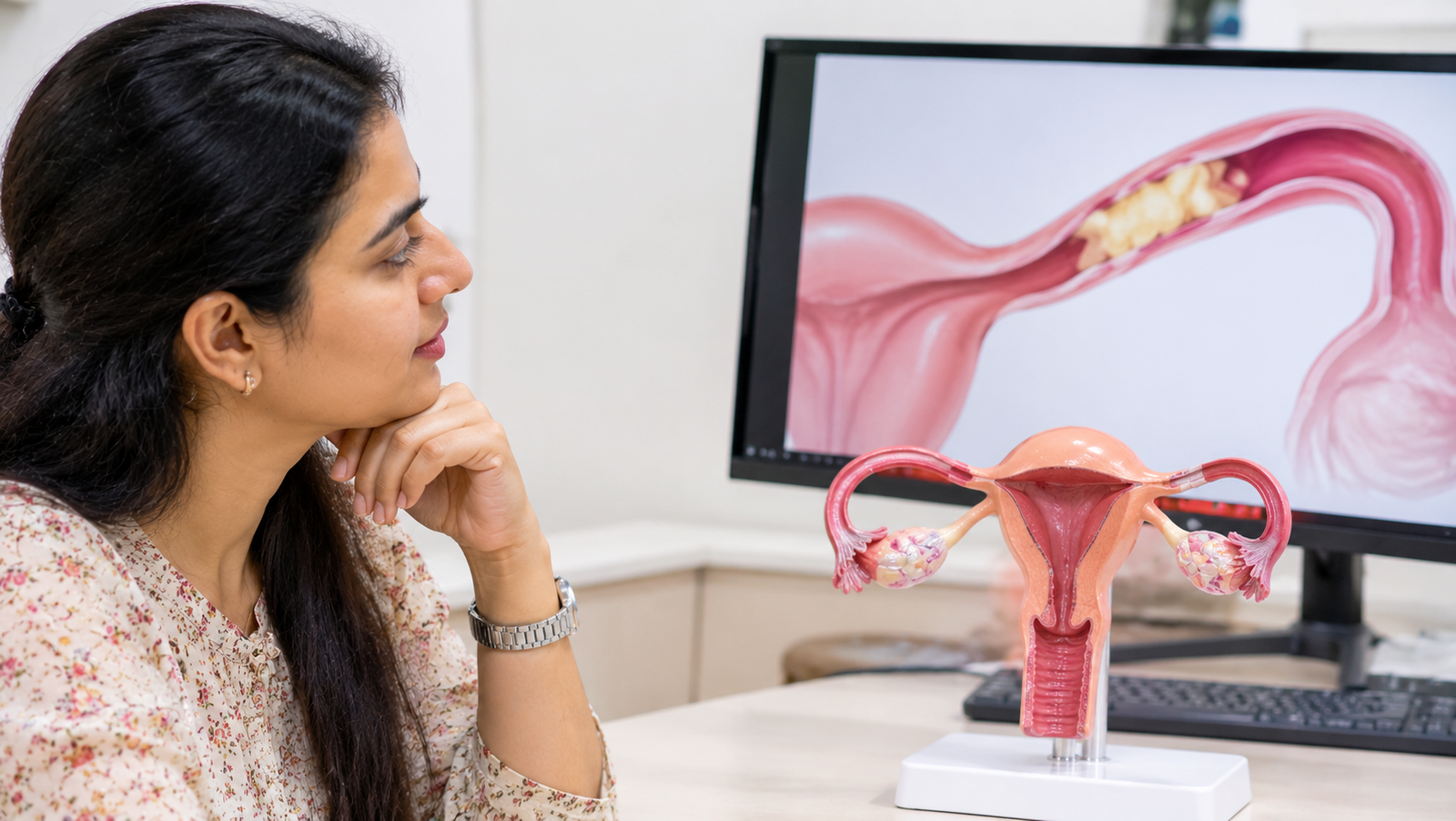
Blocked fallopian tubes can prevent the egg and sperm from meeting, making natural conception difficult. Treatment in Surat may involve HSG testing, further evaluation with laparoscopy, selected surgical procedures, or IVF, which bypasses the fallopian tubes. Tubal disease contributes to approximately of female infertility cases.
Key Takeaways
- Blocked fallopian tubes can affect fertility, but treatment options depend on the location and severity of the blockage.
- An HSG test is commonly used to assess whether the fallopian tubes are open.
- Laparoscopy may help diagnose and treat selected tubal problems.
- IVF bypasses the fallopian tubes and may be preferable when both tubes are severely damaged.
- Hydrosalpinx may require treatment before IVF to improve the chances of pregnancy.
- A fertility specialist can help determine whether surgery, IVF, or further testing is appropriate.
Why Tubes Get Blocked
Blocked fallopian tube treatment in Surat begins with identifying the underlying cause, such as pelvic infection, endometriosis, or previous surgery. Understanding the cause helps fertility specialists recommend appropriate investigations and treatment options.
When one or both tubes become blocked, this process may be interrupted. The effect on fertility depends on whether the blockage is partial or complete, affects one or both tubes, and involves other tubal damage.
Common causes of fallopian tube blockage
1. Pelvic inflammatory disease (PID)
Pelvic infections, including those caused by certain sexually transmitted infections, may produce inflammation and scarring around the fallopian tubes.
2. Endometriosis
Endometriosis can cause inflammation, adhesions, and changes in pelvic anatomy. These changes may interfere with the normal movement of eggs through the tubes.
3. Previous abdominal or pelvic surgery
Operations involving the appendix, ovaries, uterus, or surrounding tissues may occasionally lead to adhesions that affect the fallopian tubes.
4. Previous ectopic pregnancy
An ectopic pregnancy, particularly when it affects a fallopian tube, may leave scarring or require treatment that changes tubal function.
5. Hydrosalpinx
Hydrosalpinx occurs when a damaged fallopian tube becomes blocked and fills with fluid. It can affect natural fertility and IVF outcomes.
Can blocked tubes cause symptoms?
Many women have no obvious symptoms. Tubal blockage may only be discovered during infertility investigations.
However, some women experience pelvic discomfort, painful periods, or symptoms associated with an underlying condition such as endometriosis.
A history of pelvic infection, surgery, or ectopic pregnancy may increase suspicion of tubal disease, but testing is necessary to establish the diagnosis.
Tests: HSG, Sono-HSG and Laparoscopy
The first step in blocked fallopian tube treatment in Surat is identifying whether the tubes are open, where a possible blockage exists, and whether additional pelvic conditions are present.
For patients considering blocked fallopian tube treatment in Surat, HSG is often an initial test to check whether the tubes are open. Depending on the findings, additional investigations may be recommended.
A fertility specialist may recommend one or more investigations based on medical history, ultrasound findings, and previous fertility treatment.
HSG test (Hysterosalpingography)
HSG is an X-ray examination used to evaluate the uterine cavity and fallopian tubes.
During the test, a contrast liquid is introduced through the cervix. X-ray images show whether the contrast passes through the tubes and spills into the pelvic cavity.
HSG can identify possible tubal blockage, although temporary muscular spasm may sometimes produce a misleading result.
Some women experience period-like cramps during the examination.
Sono-HSG or HyCoSy
Sonographic tubal assessment uses ultrasound and a special fluid or contrast medium to evaluate tubal patency.
It does not require conventional X-ray radiation and may be suitable for selected patients.
The choice between HSG and ultrasound-based testing depends on the available facilities, clinical findings, and specialist recommendation.
Laparoscopy
Laparoscopy is a minimally invasive surgical procedure performed under anaesthesia.
It allows the surgeon to inspect pelvic structures directly and identify conditions such as endometriosis, adhesions, or damaged fallopian tubes.
Dye may be introduced through the cervix during laparoscopy to assess whether the tubes are open.
Laparoscopy is generally reserved for cases where additional pelvic disease is suspected or surgical treatment may be beneficial.
What about hysteroscopy?
Hysteroscopy examines the inside of the uterus using a thin camera introduced through the cervix.
It can identify uterine cavity abnormalities and may help assess or treat selected problems near the openings of the fallopian tubes.
However, hysteroscopy alone does not evaluate the entire length of both tubes.
For more information, explore hysteroscopy in Surat.
When Surgery Can Help
Surgery may be considered when a blocked tube has a potentially correctable problem and the remaining reproductive anatomy is reasonably healthy.
The decision depends on the patient’s age, ovarian reserve, duration of infertility, tubal damage, and other fertility factors.
Surgical options for tubal blockage
Tubal cannulation: In selected cases of proximal blockage, a specialist may attempt to reopen the tube using a catheter.
Adhesiolysis: Laparoscopic surgery may remove adhesions around the tubes or ovaries to improve their mobility and function.
Tubal reconstructive surgery: Selected distal blockages may be treated surgically, although results depend on the degree of damage.
Salpingectomy: Removal of a severely damaged tube may be recommended in certain situations, particularly before IVF when hydrosalpinx is present.
Surgery does not guarantee restored fertility. Even when a tube becomes open, internal damage may continue to affect egg transport.
Additionally, previous tubal disease can increase the risk of ectopic pregnancy. Early ultrasound assessment is important after a positive pregnancy test.
Decision Table: Finding and Likely Treatment
| Clinical finding | Likely treatment or next step |
|---|---|
| One tube open and healthy | Consider natural conception or other fertility treatment depending on additional factors |
| Suspected proximal blockage on HSG | Confirm findings; consider selective tubal cannulation |
| Mild adhesions around the tubes | Consider laparoscopic adhesiolysis in selected cases |
| Severe bilateral tubal damage | IVF is often preferred |
| Hydrosalpinx before IVF | Consider salpingectomy or proximal tubal occlusion |
| Endometriosis with tubal disease | Individualised surgery or IVF assessment |
| Uncertain HSG result | Additional testing based on specialist evaluation |
This table provides general guidance. A fertility specialist must review the complete clinical picture before recommending treatment.
When IVF Is the Better Choice
In vitro fertilisation (IVF) is an important treatment option for patients with significant tubal infertility.
Blocked fallopian tube treatment in Surat may include IVF when both tubes are severely damaged or surgery is unlikely to restore normal tubal function. IVF bypasses the tubes, allowing fertilisation to take place in a laboratory.
Unlike natural conception, IVF does not require the fallopian tubes to transport eggs or embryos.
During IVF, eggs are collected from the ovaries and fertilised with sperm in a laboratory. A suitable embryo may then be transferred into the uterus.
When may IVF be recommended?
IVF may be considered when:
- Both fallopian tubes are severely blocked or damaged.
- Previous tubal surgery has not resulted in pregnancy.
- Significant tubal damage makes reconstructive surgery less promising.
- Other infertility factors, including male-factor infertility, are present.
- Age, ovarian reserve, or duration of infertility makes delaying treatment less appropriate.
IVF success depends on several factors, including age, egg and sperm quality, embryo development, uterine conditions, and the treatment approach.
[Clinic-specific IVF success rates, if published, require doctor approval and a clearly defined patient group and outcome measure.]
IVF or tubal surgery: which is better?
Neither approach is universally suitable for every patient.
Surgery may offer an opportunity for natural conception in selected cases, while IVF may avoid the delays and limitations associated with repairing severely damaged tubes.
Patients considering IVF treatment should discuss their reproductive goals, medical findings, treatment risks, and financial considerations with a fertility specialist.
Hydrosalpinx Before IVF
Hydrosalpinx is a condition in which a damaged fallopian tube becomes filled with fluid, often following infection or inflammation.
This fluid may enter the uterine cavity and interfere with embryo implantation.
Consequently, untreated hydrosalpinx can reduce the chances of successful IVF treatment.
Why is hydrosalpinx important?
The American Society for Reproductive Medicine (ASRM) reports that hydrosalpinx can negatively affect IVF outcomes. Its guidance supports treating clinically significant hydrosalpinx before embryo transfer in appropriate patients. ASRM
Possible treatments include laparoscopic salpingectomy or proximal tubal occlusion.
The appropriate procedure depends on the condition of the tube, surgical risks, ovarian reserve, and the patient’s fertility plan.
Getting tubal block treatment near ring road surat
Patients seeking tubal block treatment near ring road surat should begin with a fertility consultation rather than assuming surgery is necessary.
At Paaranu IVF, Dr. Jayesh Patel (MD, DGO), with over 25 years of experience, provides fertility assessment and individualised treatment planning. Paaranu IVF
During the consultation, patients can discuss previous HSG reports, ultrasound findings, menstrual history, previous pregnancies, and available fertility treatments.
For individualised guidance, consult the fertility specialists in Surat.
Evidence-Based Treatment Summary
According to the ASRM committee opinion Role of Tubal Surgery in the Era of Assisted Reproductive Technology (2021):
- Tubal disease accounts for approximately 25–35% of female-factor infertility cases.
- HSG is recommended as a first-line investigation of tubal patency.
- Selected proximal blockages may be treated with tubal cannulation.
- Severe tubal damage may favour IVF over reconstructive surgery.
- Treating hydrosalpinx before IVF can improve reproductive outcomes.
These figures describe published research populations and are not Paaranu IVF-specific success rates.
Frequently Asked Questions
A genuinely scarred or severely damaged fallopian tube usually does not reopen naturally. However, an HSG result suggesting blockage may sometimes reflect temporary tubal spasm rather than permanent obstruction. Repeat testing or selective tubal cannulation may be recommended before deciding whether surgery or IVF is necessary.
An HSG test may cause mild to moderate cramping when contrast liquid enters the uterus and fallopian tubes. Discomfort usually settles after the procedure, although experiences vary. Your fertility specialist can explain pain-relief options, preparation instructions, and symptoms that require medical attention after testing.
Yes. Natural pregnancy may still be possible when one fallopian tube is open and functioning properly. However, age, ovulation, sperm quality, and other fertility conditions also influence conception. A specialist can assess whether natural attempts, fertility medication, IUI, or IVF would be appropriate.
IVF can help patients with blocked fallopian tubes because fertilisation takes place outside the body, bypassing the tubes. However, IVF does not guarantee pregnancy. If hydrosalpinx is present, treatment may be recommended before embryo transfer. Patients considering tubal block treatment near ring road surat should obtain individualised fertility advice.
Conclusion
Blocked fallopian tubes do not always mean that pregnancy is impossible. Some patients may benefit from further testing or selected surgical procedures, while others may achieve better treatment prospects through IVF.
The most appropriate approach depends on the type of blockage, age, ovarian reserve, sperm parameters, and overall reproductive health.
At Paaranu IVF, Dr. Jayesh Patel helps patients evaluate available fertility treatment options through an individualised assessment.
Book a fertility consultation with Paaranu IVF to discuss HSG findings, tubal surgery, hydrosalpinx, and IVF options.