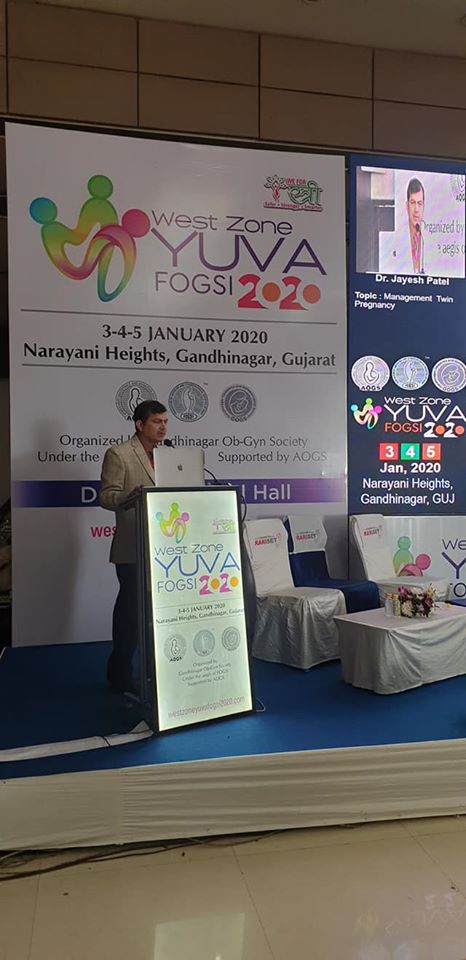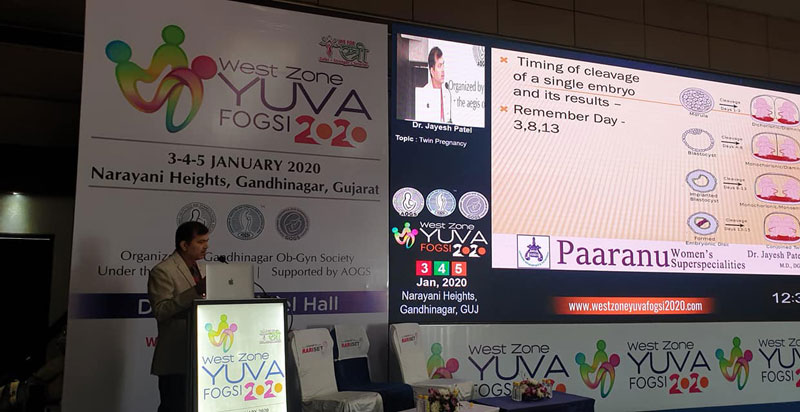
It was an honour to deliver a lecture on the management of monochorionic twins at the YUVA FOGSI conference in Ahmedabad. Twin pregnancies, and monochorionic twins in particular, are among the most demanding situations in all of obstetrics and fetal medicine, and the opportunity to discuss their management with a room full of committed young clinicians was one I valued deeply on behalf of Paaranu Women’s Superspecialities.
Monochorionic twins are identical twins who share a single placenta. This sharing is what makes them so special and, at the same time, so challenging to look after. Because the two babies draw from a common placenta and are connected through shared blood vessels, they are at risk of complications that simply do not occur in other twin pregnancies. What affects one baby can very quickly affect the other, and this interdependence demands a level of vigilance and expertise beyond that of a routine pregnancy.
In my lecture, I focused on how these pregnancies should be monitored and managed to give both babies the best possible chance. The foundation of good care is early and accurate identification, ideally in the first trimester, that a twin pregnancy is monochorionic. Once this is known, the pregnancy needs closer and more frequent surveillance than usual, with regular, carefully performed ultrasound scans to watch for the specific complications these twins can develop. Detecting a problem early is often the difference between a manageable situation and a crisis.
I discussed the serious complications that can arise when the shared circulation becomes unbalanced, and how modern fetal medicine has developed ways to identify and intervene in these situations. Advances in this field have transformed outcomes that were once frequently tragic, but they depend entirely on timely recognition and referral to centres with the right expertise. A large part of my message to the younger clinicians was about knowing what to look for, and knowing when and where to seek specialised help.
Throughout, I tried to balance the technical detail with a clear, practical framework that clinicians could carry back into their own practice. Managing monochorionic twins is not about any single dramatic intervention, but about consistent, informed and attentive care across the whole pregnancy. That is a message worth reinforcing at every opportunity.
Forums like YUVA FOGSI are precisely where this kind of knowledge is best shared. The younger generation of gynaecologists is eager to learn, and equipping them with a sound approach to high risk pregnancies has an impact that extends to countless mothers and babies over the course of their careers. The questions and discussion after the talk were sharp and engaged, and reflected a genuine commitment to doing right by these vulnerable pregnancies.
At Paaranu, we are firm believers that continued teaching and learning are the surest way to improve outcomes across the region. I am grateful to the organisers of YUVA FOGSI for the opportunity to speak, and to everyone who attended for their enthusiasm. I look forward to many more such occasions to share and to learn together.