IVF treatment involves several carefully planned stages, from ovarian stimulation and egg retrieval to fertilisation, embryo development and embryo transfer. One important decision during this process is how long embryos should be cultured in the laboratory before transfer. For couples considering blastocyst culture in Surat, understanding what happens between fertilisation and Day 5 can make the IVF process easier to follow. Blastocyst culture gives the embryology team additional time to observe embryo development, but it is not necessarily the appropriate approach for every IVF patient. For selected IVF cycles, embryos may be cultured until approximately Day 5, when a developing embryo may reach the blastocyst stage. This approach is known as blastocyst culture.
What Is Blastocyst Culture?
Blastocyst culture is a laboratory technique in which fertilised eggs are allowed to continue developing for several days under carefully controlled conditions.
After fertilisation, an embryo begins dividing into increasing numbers of cells. By around Day 5 or Day 6, some embryos develop into a more advanced structure called a blastocyst.
A blastocyst typically contains two important cell groups:
- Inner cell mass: cells that eventually contribute to the developing fetus.
- Trophectoderm: cells that contribute to structures including the placenta.
The blastocyst also contains a fluid-filled cavity as development progresses.
Not every fertilised egg will reach this stage. Embryo development varies considerably between patients and even between embryos from the same IVF cycle.
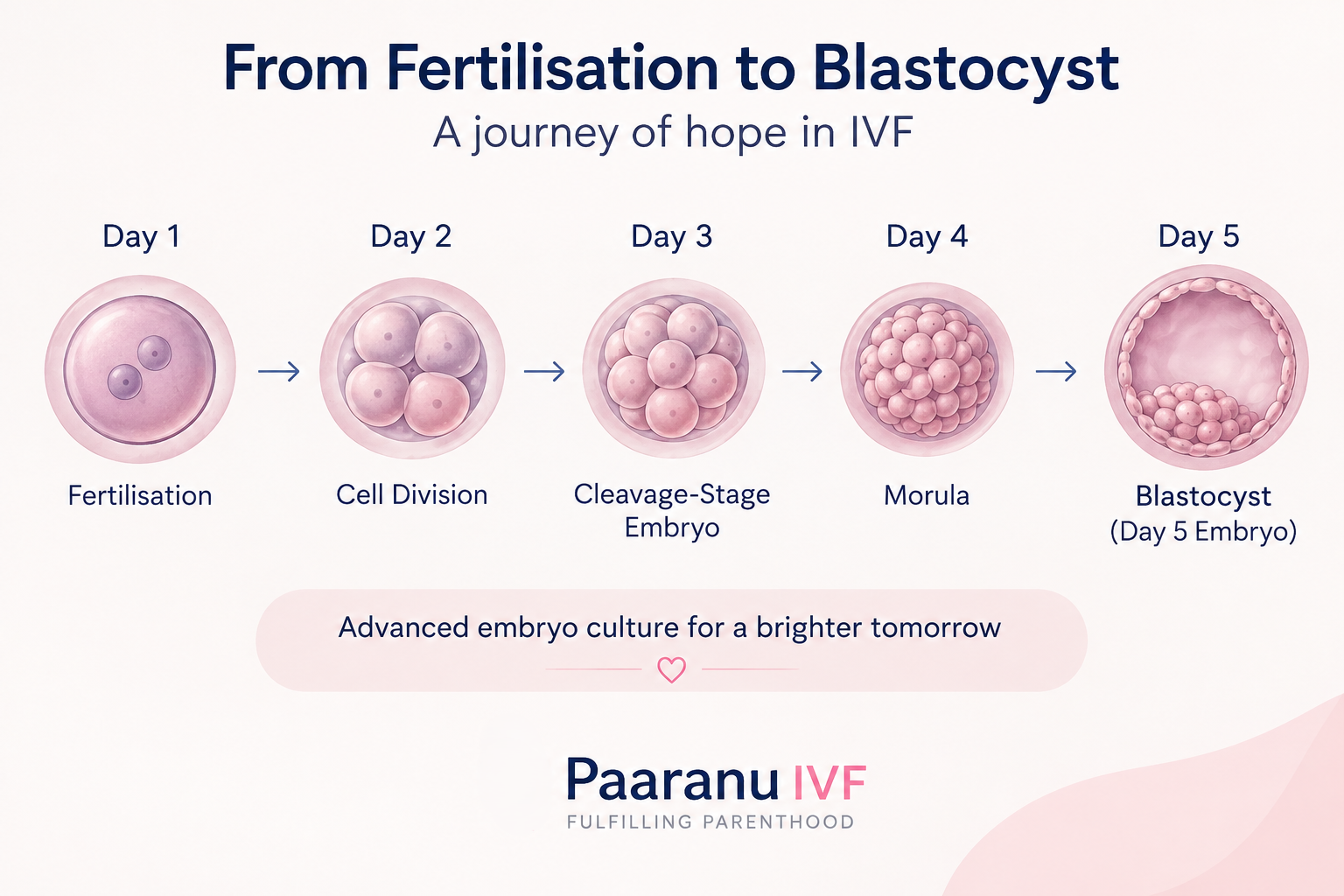
How Does an Embryo Develop From Day 1 to Day 5?
Embryo development is a continuous biological process rather than a sudden change on Day 5.
Day 1: Fertilisation Assessment
After eggs and sperm are combined through conventional IVF or another fertilisation technique, the embryology team checks whether fertilisation has occurred.
Normally, fertilised eggs are then kept in controlled laboratory conditions for continued development.
Day 2: Early Cell Division
The fertilised egg begins dividing. Embryologists observe characteristics such as cell division and overall developmental progress.
Day 3: Cleavage-Stage Embryo
By approximately Day 3, embryos have generally undergone several rounds of cell division.
Some IVF treatment plans involve embryo transfer during the cleavage stage, while others involve continuing culture.
Day 4: Morula Stage
As development continues, the cells become more compact, and the embryo may enter the morula stage.
This represents an important transition between the cleavage-stage embryo and blastocyst.
Day 5–6: Blastocyst Development
Some embryos progress to the blastocyst stage around Day 5 or Day 6.
At this point, embryologists can assess blastocyst development and morphology before deciding which embryo or embryos may be considered for transfer or cryopreservation according to the patient’s treatment plan.
Why Is Blastocyst Culture Used During IVF?
One reason for extending embryo culture is that it allows embryologists to observe development for a longer period.
When several embryos are available, additional days of laboratory observation can provide more information about which embryos continue developing appropriately.
This can help the fertility team make decisions about embryo selection.
However, reaching the blastocyst stage does not guarantee implantation or pregnancy. IVF outcomes depend on many factors, including maternal age, egg and sperm factors, embryo characteristics, uterine conditions, and the underlying cause of infertility.
Patients who want to understand the complete treatment process can also read about IVF treatment in Surat.
What Happens During Blastocyst Culture in Surat?
Blastocyst culture takes place as part of an IVF treatment cycle rather than as an isolated fertility treatment.
The general process includes:
1. Ovarian stimulation
Fertility medicines are used according to an individual treatment protocol to encourage the development of multiple follicles.
2. Monitoring
Ultrasound examinations and, where required, hormone testing help the fertility team monitor follicular development.
3. Egg retrieval
When the follicles have reached the appropriate stage, eggs are retrieved from the ovaries.
4. Fertilisation
Retrieved mature eggs are fertilised using conventional IVF or techniques such as ICSI when clinically appropriate.
5. Embryo culture
After fertilisation, developing embryos are maintained in controlled laboratory conditions.
6. Blastocyst assessment
Embryologists monitor development over the following days. Embryos that continue developing may reach the blastocyst stage around Day 5 or Day
7. Embryo transfer or freezing
Depending on the individual treatment plan, an appropriate blastocyst may be considered for transfer, while suitable additional embryos may be cryopreserved for potential future use.
How Are Blastocysts Evaluated?
Embryologists evaluate several characteristics of a developing blastocyst.
Assessment may consider the degree of blastocyst expansion and the appearance of the inner cell mass and trophectoderm.
These observations help describe blastocyst morphology and development.
It is important to understand that embryo grading is an assessment tool rather than a guarantee. A visually favourable blastocyst does not guarantee pregnancy, while treatment decisions should not be based on a grade without considering the patient’s wider clinical situation.
Day 3 vs Day 5 Embryo Transfer
Patients commonly wonder whether Day 3 or Day 5 transfer is better.
There is no single answer that applies to every IVF cycle.
| Factor | Day 3 Transfer | Day 5 Blastocyst Transfer |
|---|---|---|
| Embryo stage | Cleavage stage | Blastocyst stage |
| Time in laboratory | About 3 days | About 5–6 days |
| Developmental observation | Shorter | Longer |
| Embryo selection information | Earlier assessment | More developmental information available |
| Suitable for everyone? | No | No |
The decision can depend on the number and development of embryos, previous IVF history, patient characteristics and the fertility team’s clinical assessment.
What Are the Potential Benefits of Blastocyst Culture?
More Time to Observe Embryo Development
Keeping embryos in culture for additional days allows embryologists to see which embryos continue developing toward the blastocyst stage.
Additional Information for Embryo Selection
When several embryos are developing, extended culture can provide additional developmental information that may assist embryo selection.
Supports Selected Embryo-Transfer Strategies
Blastocyst culture can form part of an individualized embryo-transfer plan based on the patient’s circumstances and embryo development.
Cryopreservation of Suitable Blastocysts
When suitable additional blastocysts are available, they may be frozen for potential future treatment.
Paaranu IVF also provides cryopreservation services in Surat for fertility preservation and the storage of embryos, eggs, and sperm.
Are There Limitations to Blastocyst Culture?
Yes. Blastocyst culture has important limitations that patients should understand before treatment.
Not Every Embryo Reaches Day 5
Some embryos stop developing before reaching the blastocyst stage. This is part of embryo development and can occur even when fertilisation initially appears normal.
There May Be No Blastocyst Available for Transfer
If only a small number of embryos are available, extending culture may carry a possibility that none will develop sufficiently for a Day 5 transfer.
It Cannot Guarantee Pregnancy
A blastocyst reaching Day 5 does not mean implantation will definitely occur.
Pregnancy depends on multiple biological factors beyond the developmental stage of the embryo.
It Is Not Necessary for Every IVF Cycle
Some patients may be advised to have an earlier embryo transfer depending on their individual situation.
For this reason, the decision to use blastocyst culture should be individualized rather than automatically applied to every IVF cycle.
Who May Be Considered for Blastocyst Culture?
A fertility specialist and embryology team may consider extended embryo culture based on the overall IVF situation.
Factors that may influence the decision include:
- Number of fertilised eggs and developing embryos
- Embryo development during the first few days
- Age and reproductive history
- Previous IVF treatment outcomes
- Planned embryo-transfer strategy
- Need for additional embryo-related procedures
- Overall fertility diagnosis
The presence of one factor alone does not automatically mean that blastocyst culture should be used.
What Is the Role of ICSI Before Blastocyst Culture?
ICSI and blastocyst culture refer to different stages of IVF.
ICSI is a fertilisation technique. An embryologist injects a selected sperm directly into a mature egg to assist fertilisation.
Blastocyst culture occurs after fertilisation, when the resulting embryos are cultured and monitored for several days.
Therefore, some patients may undergo ICSI followed by blastocyst culture, while others may have conventional IVF followed by blastocyst culture.
You can learn more about ICSI treatment in Surat and when this fertilisation technique may be considered.
Does Blastocyst Culture Improve IVF Success?
This question needs to be considered carefully.
Blastocyst culture can provide more information about embryo development and may help with embryo selection in appropriate patients. However, it should not be interpreted as a method that guarantees IVF success.
IVF outcomes can be affected by:
- Woman’s age
- Ovarian reserve
- Egg quality
- Sperm factors
- Number and development of embryos
- Uterine health
- Underlying fertility conditions
- Previous reproductive history
A fertility specialist should therefore assess the complete clinical picture rather than recommending blastocyst culture solely on the basis of an expected success rate.
What Happens After a Blastocyst Transfer?
After an embryo is transferred, patients usually continue medications prescribed by their fertility specialist.
The clinic will provide instructions regarding daily activities, medication, and when to perform the pregnancy test.
Strict bed rest is generally not the purpose of embryo-transfer aftercare unless a doctor has given specific instructions for an individual medical reason.
Patients should avoid stopping prescribed fertility medicines on their own, even if they experience mild spotting or other symptoms before the scheduled pregnancy test.
What Questions Should You Ask Before Blastocyst Culture?
Before treatment, consider asking your fertility team:
- How many embryos are currently developing?
- Why are you recommending Day 5 culture in my case?
- What happens if none of my embryos reach the blastocyst stage?
- How will the embryos be assessed?
- How many embryos are planned for transfer?
- What happens to additional suitable blastocysts?
- Would freezing be recommended in my treatment cycle?
Clear answers can help patients understand why a particular embryo-culture strategy has been selected.
Blastocyst Culture at Paaranu IVF in Surat
Paaranu IVF offers blastocyst culture as part of its range of fertility and assisted reproductive services in Surat. The clinic also provides IVF, IUI, ICSI, IMSI, assisted hatching and cryopreservation services.
Dr. Jayesh Patel, MD, D.G.O., is the Clinical Director at Paaranu IVF and has over 25 years of experience in gynecology, fertility, and fetal medicine.
The decision to use blastocyst culture should be based on the individual patient’s fertility history, the number and development of embryos, previous treatment and the overall IVF plan rather than following the same approach for every patient.
Conclusion
Blastocyst culture in Surat is an advanced part of IVF laboratory care in which embryos are allowed to develop for approximately five to six days after fertilisation. Embryos that continue developing may reach the blastocyst stage, giving the embryology team additional information for embryo assessment and selection.
However, not every embryo will reach Day 5, and blastocyst culture is not automatically appropriate for every IVF patient. It also cannot guarantee implantation or pregnancy.
A personalized fertility evaluation can help determine whether Day 5 blastocyst culture fits your IVF treatment plan. Patients considering IVF or blastocyst culture can consult the fertility team at Paaranu IVF in Surat to understand their options based on their individual fertility situation.
Frequently Asked Questions
What is blastocyst culture in IVF?
Blastocyst culture involves allowing fertilised eggs to develop in controlled laboratory conditions for approximately five to six days, when some embryos may reach the blastocyst stage.
Is a blastocyst always formed on Day 5?
No. Some embryos may reach the blastocyst stage on Day 5, while others may develop later or stop developing before reaching this stage.
Is Day 5 embryo transfer better than Day 3?
Neither approach is automatically better for every patient. The decision depends on embryo development, the number of available embryos and the patient’s individual treatment plan.
Does blastocyst culture guarantee pregnancy?
No. Blastocyst culture does not guarantee implantation or pregnancy. Age, embryo factors, uterine health, and the underlying fertility condition can all influence IVF outcomes.
What happens to additional blastocysts?
Suitable blastocysts that are not transferred may potentially be cryopreserved when appropriate, according to the patient’s treatment plan and clinical guidance.
Is blastocyst culture suitable for every IVF patient?
No. Whether extended culture is appropriate depends on the individual IVF cycle, embryo development, reproductive history, and other clinical factors.