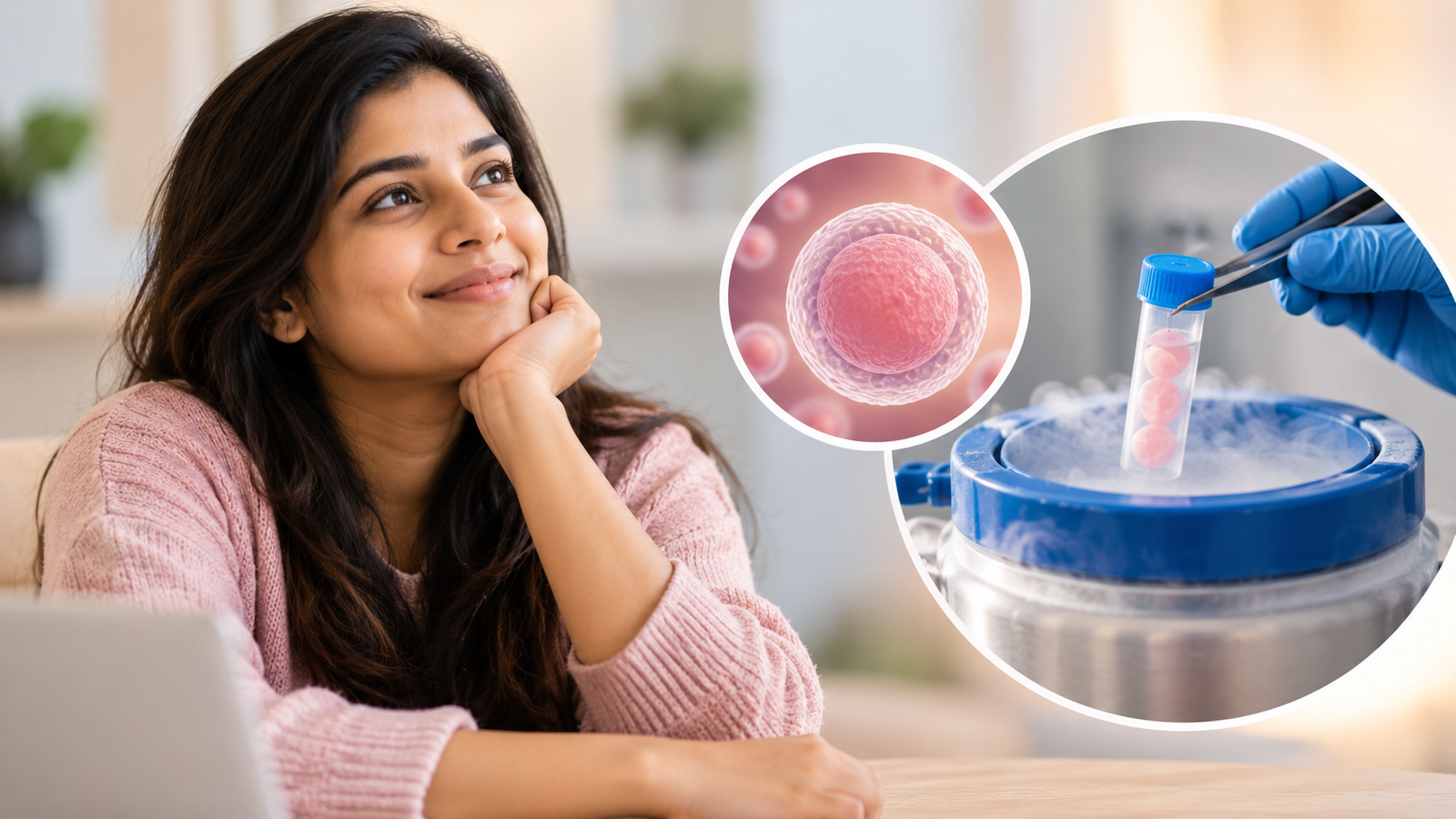
The egg freezing cost in India varies according to the fertility centre, ovarian stimulation medicines, tests, egg retrieval procedure, vitrification, and storage period. There is no single price that applies to every woman because medicine requirements and the number of treatment cycles can differ. Understanding each component of the cost is more useful than comparing package prices alone.
Egg freezing, medically called oocyte cryopreservation, allows unfertilised eggs to be collected and preserved for possible use in the future. Women may consider it for personal, reproductive, or medical reasons, particularly when they want to preserve younger eggs before fertility naturally declines with age.
However, freezing eggs is not a guarantee of a future pregnancy. Age at freezing, number of mature eggs stored and their survival after warming are among the factors that can influence the eventual outcome.
What Is Egg Freezing?
Egg freezing is a fertility-preservation procedure in which the ovaries are stimulated to develop multiple follicles. Mature eggs are then collected through an egg retrieval procedure and frozen for future use.
Modern fertility laboratories generally use vitrification, a rapid-freezing technique designed to minimise the formation of damaging ice crystals within the egg.
Unlike embryo freezing, egg freezing does not require the eggs to be fertilised before storage.
When a woman later decides to try for pregnancy using her frozen eggs, the eggs are warmed, and surviving mature eggs may be fertilised with sperm. The resulting embryos are cultured, and an appropriate embryo may subsequently be transferred to the uterus.
What Is the Egg Freezing Cost in India?
There is no universal fixed egg freezing cost in India.
The total expense depends on several separate components, including:
- Initial fertility consultation
- Ovarian reserve assessment
- Blood investigations
- Ultrasound monitoring
- Ovarian stimulation medicines
- Egg retrieval procedure
- Anaesthesia or sedation
- Laboratory handling
- Vitrification of mature eggs
- Initial storage
- Annual or long-term storage charges
Some fertility centres may quote a package covering the procedure and freezing but exclude medicines or future storage. Others may structure their charges differently.
For this reason, when comparing costs, ask what exactly is included in the quoted amount.
A lower initial package may not necessarily mean a lower total cost if medicines, investigations, anaesthesia or storage are charged separately.
What Is Included in Egg Freezing Cost?
An egg-freezing cycle has several stages, and each can contribute to the final cost.
Consultation and fertility assessment
Before starting treatment, the fertility specialist evaluates reproductive history, age, menstrual cycles, and the reason for considering fertility preservation.
Ovarian reserve tests may be recommended to estimate how the ovaries are likely to respond to stimulation.
Ovarian stimulation
Hormonal medicines are generally given for several days to encourage multiple follicles to develop during the same cycle.
The exact medicines and doses vary between patients.
Ultrasound and blood-test monitoring
Follicles are monitored during stimulation so the fertility team can assess their growth and determine when the eggs may be ready for retrieval.
Egg retrieval
Once follicles reach an appropriate stage, a trigger medication is used according to the treatment protocol and egg retrieval is scheduled.
Vitrification
Suitable mature eggs are frozen in the embryology laboratory using vitrification and stored under controlled conditions.
Understanding these separate stages makes it easier to compare egg-freezing costs between fertility centres.
Are Medicines and Tests Included in the Price?
Not always.
This is an important question to ask when discussing the egg freezing cost in India.
Ovarian stimulation medicines can represent a significant part of the total expense, and the dose required varies from one woman to another.
A woman with a different ovarian reserve or expected response may require a different medication protocol. Therefore, two women having egg freezing at the same centre may not necessarily have identical medicine costs.
Before starting treatment, ask whether the estimate includes:
- Hormonal medicines
- Blood investigations
- Ultrasound monitoring
- Egg retrieval
- Anaesthesia
- Laboratory charges
- Egg vitrification
- Initial storage
- Future annual storage
A detailed estimate helps prevent confusion about additional expenses later.
How Much Does Annual Egg Storage Cost?
Egg freezing does not end with egg retrieval and vitrification. The frozen eggs need to remain stored until they are used or the woman decides to discontinue storage.
Storage charges are generally separate from the initial treatment cost after the included storage period ends.
Fees can differ according to the fertility centre and the length of storage.
Women considering egg freezing should therefore ask about both the initial freezing cost and recurring storage charges.
If you intend to preserve eggs for several years, storage becomes part of the long-term financial planning for fertility preservation.
Why Does Egg Freezing Cost Vary Between Patients?
The cost can vary even between two women undergoing treatment at the same fertility centre.
One major reason is the response to ovarian stimulation.
Some women may develop an appropriate number of follicles with relatively modest medicine doses. Others may need higher doses or a different protocol.
The number of cycles can also have a major effect.
If the first retrieval produces fewer mature eggs than expected, a woman may decide after counselling to undergo another stimulation and retrieval cycle to store additional eggs. Each additional cycle adds treatment, medicine, and laboratory expenses.
This is why Dr. Jayesh Patel, MD, D.G.O., Clinical Director & IVF Specialist at Paaranu IVF, with over 25 years of experience in gynecology, fertility and fetal medicine, considers age, ovarian reserve and individual reproductive circumstances when counselling women about fertility-preservation planning. The goal is to understand the clinical situation before estimating what treatment may involve rather than relying only on a generic package price.
Who Should Consider Freezing Their Eggs?
There is no single profile of a woman who should freeze her eggs.
Egg freezing may be considered for different reasons.
Women delaying pregnancy
Some women may not currently be ready to have children because of education, career, personal circumstances, or because they have not found the right partner.
Because fertility and egg quality decline with age, they may wish to discuss preserving eggs at a younger age.
Women undergoing certain medical treatments
Some cancer treatments, particularly specific chemotherapy or radiotherapy regimens, can affect ovarian function.
When medically appropriate and when there is sufficient time before treatment begins, fertility preservation may be discussed.
Women facing ovarian surgery
Certain ovarian conditions or repeated ovarian surgery can potentially affect ovarian reserve. Depending on the diagnosis and treatment plan, fertility preservation may be worth discussing before surgery.
Women with conditions that may affect ovarian reserve
Some women have medical or reproductive factors that suggest their ovarian reserve may decline earlier than expected.
Egg freezing may be one option, although suitability needs individualized assessment.
Women who want greater reproductive flexibility
A woman may simply want to understand whether preserving eggs now could provide another reproductive option later.
The decision should be based on realistic counselling about benefits, limitations, costs, and future use rather than fear about fertility.
What Is the Best Age for Egg Freezing?
Age at the time of freezing is one of the most important considerations.
Women are born with a finite number of eggs. Both egg quantity and quality generally decline with increasing age, although the rate of decline varies between individuals.
Freezing eggs at a younger age generally means preserving eggs from a biologically earlier stage.
However, this does not mean every young woman needs to freeze her eggs.
The decision needs to balance:
- Current age
- Ovarian reserve
- Reproductive plans
- Medical history
- Expected time before trying for pregnancy
- Number of eggs that may be retrieved
- Financial considerations
- Personal circumstances
Waiting until fertility has already declined substantially may reduce the number or quality of eggs available for freezing.
Women considering postponing pregnancy for several years can therefore benefit from discussing their individual situation with a fertility specialist rather than waiting for a particular age cut-off.
How Does the Egg Freezing Process Work?
The process usually begins with a fertility consultation and assessment.
Step 1: Fertility evaluation
The fertility specialist reviews medical history, menstrual cycles, reproductive plans, and relevant health conditions.
Ovarian reserve assessment may include ultrasound and blood tests when appropriate.
Step 2: Ovarian stimulation
Hormonal injections are used to stimulate the ovaries so that several follicles can develop during one cycle.
Step 3: Monitoring
Ultrasound examinations, and sometimes hormonal blood tests, are used to monitor follicular development and adjust treatment when necessary.
Step 4: Trigger and egg retrieval
When follicles reach an appropriate stage, final maturation is triggered according to the treatment protocol.
Egg retrieval is then performed using ultrasound guidance.
Step 5: Egg assessment
The retrieved eggs are examined in the laboratory. Eggs that have reached an appropriate stage of maturity can be considered for freezing.
Step 6: Vitrification and storage
Mature eggs are vitrified and stored under controlled laboratory conditions for possible future use.
The entire treatment schedule should be explained by the fertility team before the cycle begins.
How Many Eggs Should You Freeze?
There is no number of frozen eggs that can guarantee a future baby.
The number of eggs a woman may wish to store depends on several factors, particularly her age when the eggs are frozen.
Not every retrieved egg will necessarily be mature enough for freezing. Later, not every frozen egg will necessarily survive warming, fertilise normally, develop into a suitable embryo or result in pregnancy.
This biological attrition is why fertility specialists discuss probabilities rather than guarantees.
A woman who retrieves fewer mature eggs than expected may consider another cycle, depending on her age, ovarian reserve, reproductive goals and financial circumstances.
This possibility should also be considered when estimating the overall cost of egg freezing.
Does Freezing Eggs Guarantee a Future Pregnancy?
No.
This is one of the most important points to understand before proceeding with elective egg freezing.
Egg freezing preserves an opportunity; it does not guarantee a future pregnancy or live birth.
Future outcomes can depend on:
- Age when the eggs were frozen
- Number of mature eggs stored
- Egg survival after warming
- Fertilisation
- Embryo development
- Sperm factors
- Uterine and maternal health at the time of treatment
- Other reproductive factors
A trustworthy fertility consultation should discuss these limitations clearly rather than presenting egg freezing as fertility insurance with a guaranteed result.
At Paaranu IVF, counselling under the guidance of Dr. Jayesh Patel and the fertility team can help women understand both the potential benefits and limitations of fertility preservation before deciding whether treatment fits their reproductive plans.
What Happens When You Want to Use Frozen Eggs?
When a woman decides to use her stored eggs, selected eggs are warmed in the embryology laboratory.
Eggs that survive warming can then be fertilised.
Because freezing can affect the egg’s outer covering and only a limited number of stored eggs may be available, ICSI, where a selected sperm is injected directly into the egg, is commonly used when fertilising previously vitrified eggs.
The fertilised eggs are then monitored for embryo development.
If suitable embryos develop, an embryo may be transferred to the uterus according to the treatment plan.
It is important to understand that the future treatment required to use frozen eggs has its own costs. These are separate from the original expense of retrieving and storing the eggs.
Egg Freezing and Fertility Preservation at Paaranu IVF
Women considering egg freezing should receive more than a price quotation. They need an assessment of whether fertility preservation is appropriate for their age, ovarian reserve, and future reproductive plans.
At Paaranu IVF, Dr. Jayesh Patel, MD, D.G.O., with more than 25 years of experience in fertility and gynecological care, and the fertility team can evaluate these factors before planning ovarian stimulation and egg retrieval.
The consultation should also help a woman understand approximately what the treatment involves, whether more than one retrieval cycle may need to be considered, how eggs are stored and what additional treatment would be required if she chooses to use those eggs later.
This individualized approach is particularly important because the lowest egg freezing cost in India is not necessarily the most important factor. Laboratory standards, clinical assessment, transparent counselling, realistic expectations, and long-term storage arrangements also matter when choosing where to preserve eggs.
Questions to Ask Before Paying for Egg Freezing
Before choosing a fertility centre, ask for clarity about the complete treatment rather than comparing only the headline package amount.
Useful questions include:
- What does the quoted price include?
- Are stimulation medicines charged separately?
- Are monitoring scans and blood tests included?
- Is anaesthesia included in egg retrieval charges?
- Is vitrification included?
- How much storage is included initially?
- What are the annual storage charges afterward?
- What happens if I need another retrieval cycle?
- How will my eggs be identified and stored?
- What costs will apply when I eventually use the eggs?
- What happens if I no longer want to continue storage?
Clear answers to these questions can make cost comparisons much more meaningful.
Key Takeaways
The egg freezing cost in India is not simply the price of freezing eggs. The total expense can include fertility assessment, ovarian stimulation medicines, monitoring, egg retrieval, laboratory vitrification and ongoing storage.
Costs also vary because every woman responds differently to ovarian stimulation, and some may consider more than one retrieval cycle to store additional mature eggs.
Age at freezing is an important factor because egg quantity and quality generally decline over time. However, egg freezing does not guarantee a future pregnancy.
Women considering fertility preservation should therefore look beyond price alone. Individual fertility assessment, laboratory quality, transparent cost information, realistic counselling and an understanding of future treatment requirements are all important when making the decision.
Frequently Asked Questions
What is the average egg freezing cost in India?
The total cost varies between fertility centres and patients because consultation, investigations, stimulation medicines, egg retrieval, vitrification and storage may be charged differently. Rather than relying on an average online figure, ask for a written estimate explaining exactly what is included and which expenses are additional.
Are medicines included in egg freezing cost?
Not necessarily. Some fertility centres quote procedural charges separately from ovarian stimulation medicines. Medicine requirements also differ according to ovarian reserve and response to stimulation. Ask whether the quoted egg freezing cost in India includes medicines, monitoring scans, blood tests, retrieval, anaesthesia, freezing and storage.
Do I have to pay every year for frozen egg storage?
Long-term storage usually involves recurring fees after any initial storage period included in the treatment package. The amount and payment schedule vary between fertility centres. If you expect to store eggs for several years, ask about annual or long-term storage charges before beginning treatment.
What is the best age to freeze eggs?
There is no single best age for every woman. Egg quality generally declines with age, so freezing at a younger reproductive age may preserve younger eggs. However, ovarian reserve, future pregnancy plans, medical history, expected delay in childbearing, and personal circumstances should all be considered.
How long can frozen eggs be stored?
Modern vitrification allows eggs to remain cryopreserved for extended periods when maintained under appropriate laboratory conditions. However, legal, regulatory, and clinic policies regarding storage duration can vary. Ask your fertility centre about the applicable storage rules, consent requirements and renewal arrangements before treatment.
How many eggs should I freeze for one baby?
No specific number of eggs can guarantee one future baby. Not every frozen egg will survive warming, fertilise, develop into a suitable embryo or result in pregnancy. Age at freezing strongly influences expectations, so the target number of eggs should be discussed individually with a fertility specialist.
Can I freeze my eggs if I am unmarried?
Egg freezing may be considered by women who are not currently ready for pregnancy or who wish to preserve reproductive options for the future. Suitability depends on medical assessment and applicable regulations rather than marital status alone. A fertility specialist can explain the treatment and consent requirements.
Does egg freezing guarantee pregnancy later?
No. Egg freezing preserves eggs for possible future use but cannot guarantee pregnancy or a live birth. Future success depends on factors including age when the eggs were frozen, number and quality of stored eggs, survival after warming, fertilisation, embryo development and reproductive health later.